
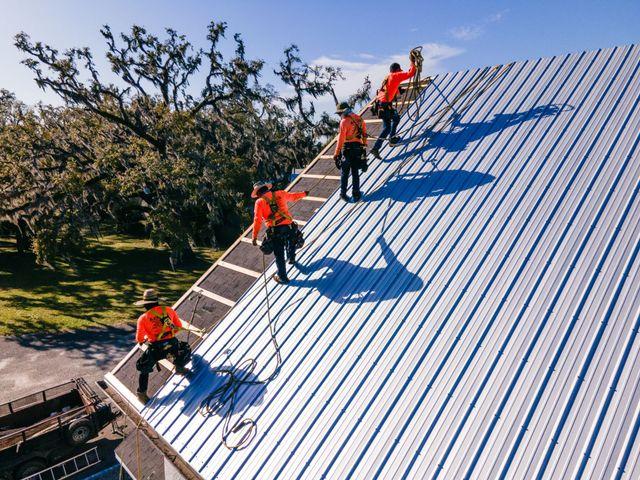
Commercial Metal Roofing Guide
A commercial metal roof is one of the few roofing systems that can realistically deliver 40 to 70 years of service while reducing energy costs and standing up to Florida’s hurricanes. Although the installed cost is higher than many alternatives, the lower maintenance, longer lifespan, and stronger long-term return often make it the smarter investment.
Commercial property owners across the U.S. spend billions replacing roofs every year, yet many conventional systems need another replacement within two decades. A properly designed metal roofing system can withstand winds exceeding 140 mph, lower cooling expenses by 25% or more, and help reduce lifecycle costs instead of repeating the replacement cycle.
Whether you’re planning a commercial metal roof replacement for a warehouse in Orlando, an industrial facility in Sanford, a retail center in Kissimmee, or a new office building in Daytona or Port Orange, the right system depends on far more than the lowest bid. Understanding roof types, installed costs, expected lifespan, coatings, and performance is what separates a short-term expense from a long-term asset.
Why Metal Roofing Makes Sense for Commercial Buildings
For most commercial properties, the biggest expense isn’t installing a new roof; it’s replacing it again too soon. That’s why more owners of warehouses, office buildings, retail centers, and industrial facilities are choosing commercial metal roofing with lifecycle cost in mind instead of chasing the lowest upfront price. The long-term advantages become clear when you look at the numbers:
- Longer service life: A properly installed commercial metal roofing system typically lasts 40–70 years, while many single-ply and asphalt roofs reach replacement in 15–25 years.
- Lower total ownership cost: Fewer repairs, less maintenance, improved energy performance, and fewer tear-offs help offset the higher installed cost over time.
- A more sustainable solution: Metal roofs are fully recyclable at the end of their service life, often contain significant recycled content, and retrofit installations can keep thousands of pounds of roofing material out of landfills.
- Growing industry confidence: Demand for commercial metal roofs continues to rise as stricter energy codes, severe weather, and long-term operating costs influence purchasing decisions. Industry forecasts project steady market growth through 2030, supported by data from the Metal Roofing Alliance and Dodge Construction Outlook.
Why Commercial Metal Roofs Stand Out
- Lower cooling costs: Reflective metal roofs can reduce cooling energy use by 10–25% while helping buildings meet modern energy-efficiency standards.
- Built for severe weather: Many systems achieve Class 4 impact resistance, UL 580 Class 90 wind uplift ratings, and Class A fire ratings, making them well suited for Florida’s hurricane-prone climate.
- Potential insurance savings: Some insurers offer lower premiums for commercial buildings with impact-resistant and fire-rated metal roofing.
- Design flexibility: Standing seam panels and exposed-fastener systems are available in numerous colors, profiles, and finishes, making them suitable for everything from distribution centers in Orlando and Sanford to retail developments in Kissimmee and Daytona.
Don’t compare roofs using installed cost alone. Compare the cost over the next 30 to 50 years. That’s where commercial metal roofing usually delivers its strongest return.
Types of Commercial Metal Roofing Systems
Not every commercial metal roofing system is built for the same job. Roof slope, building use, budget, maintenance expectations, and Florida’s weather all influence which system will deliver the best long-term performance.
1. Standing Seam Metal Roofing
If long-term durability is the priority, standing seam commercial roofing is usually the benchmark. Vertical panels connect with raised seams that either snap together or mechanically lock, while concealed fasteners stay protected beneath the panels. This design allows the roof to expand and contract naturally as temperatures change. These roofs are best suited for:
- Office buildings
- Schools and hospitals
- Retail centers
- High-end industrial facilities
- Roofs with slopes of ¼:12 or greater
Advantages
- Outstanding weather resistance
- No exposed fasteners to maintain
- Clean architectural appearance
- Long panel lengths with fewer leak-prone joints
Trade-offs
- Installed cost typically ranges from $10–$16 per square foot
- Requires experienced installers
- Roof penetrations demand careful detailing
For standing seam panels longer than 30 feet, specify sliding clips so the panels can move freely during thermal expansion.
2. Exposed-Fastener Metal Roofing
When keeping installation costs under control is the main objective, exposed-fastener panels remain a practical choice. Corrugated, PBR, and R-panel systems are fastened directly through the panel face using screws fitted with sealing washers. You should consider this meta roofing for:
- Warehouse roofing
- Agricultural buildings
- Pre-engineered metal buildings
- Budget-conscious industrial metal roofing projects
Advantages
- Lower installed cost, generally $6–$10 per square foot
- Faster installation
- Straightforward repairs
- Widely available materials
Trade-offs
- Fasteners need periodic inspection and replacement
- Greater chance of leaks as washers age
- Shorter aesthetic lifespan than standing seam systems
Schedule a yearly fastener inspection. Most leaks in exposed-fastener roofs begin with loose screws or deteriorated washers.
3. Retrofit Metal Roof Systems
Replacing a roof doesn’t always require tearing the old one off. Retrofit commercial metal roofing systems use a sub-framing system to install new panels over an existing roof, provided the structure is still sound.
This approach is especially valuable when a tear-off would interrupt operations or create significant disposal costs. You’ll get the best results with retrofit meta roof system on:
- Warehouses
- Manufacturing facilities
- Distribution centers
- Occupied commercial buildings
- Projects needing additional insulation
Advantages
- Eliminates most tear-off expenses
- Minimizes landfill waste
- Business operations can often continue during installation
- Opportunity to improve insulation and roof drainage
Trade-offs
- Structural evaluation is essential
- Adds additional dead load
- Not compatible with every existing roof assembly
If the existing roof structure is in good condition, a retrofit system can significantly reduce the cost and disruption of a commercial metal roof replacement.
Roof Hugger® sub-framing systems are widely used for metal-over-metal and metal-over-shingle retrofit projects because they create a level surface while improving drainage and allowing additional insulation.
4. Structural vs. Architectural Metal Roofing Systems
The biggest difference between these systems is how they carry loads. Structural metal panels span directly between purlins without requiring continuous decking. They’re commonly used on warehouses, manufacturing facilities, and other pre-engineered buildings where function takes priority.
Architectural metal panels are installed over a solid deck or closely spaced supports. They provide cleaner lines, tighter weather protection, and are commonly specified for standing seam commercial roofing on offices, healthcare facilities, schools, and other architect-designed buildings.
Commercial Metal Roofing System Comparison
| System | Typical Installed Cost (2026) | Expected Lifespan | Best For | Main Advantage |
| Standing Seam | $10–$16/sq. ft. | 40–70 years | Offices, retail, schools, healthcare | Best weather protection, concealed fasteners |
| Exposed-Fastener (PBR/Corrugated) | $8–$12/sq. ft. | 25–40 years | Warehouses, agricultural, industrial buildings | Lower cost and fast installation |
| Retrofit Metal System | $10–$14/sq. ft. | 40–60 years** | Occupied commercial buildings, reroof projects | Avoids tear-off and minimizes disruption |
Pricing Warning: These are national average installed costs for 2026 and should be used for budgeting only. Your actual price may vary depending on roof size, panel gauge, coating, building height, structural repairs, roof complexity, labor rates, and local permitting.
Commercial roofing costs in Florida can differ from national averages because of wind-resistance requirements, code compliance, and regional labor conditions.
The listed lifespan refers to the new metal roofing system installed over the existing roof, assuming the structure is suitable for a retrofit.
Which Commercial Metal Roof Is Right for Your Building?
Answer these six questions to narrow down the best option for your property.
1. What’s your budget?
- $10–$16/sq. ft. → Standing Seam or Retrofit
- $8–$12/sq. ft. → Exposed-Fastener or Retrofit
- Below $8/sq. ft. → Exposed-Fastener is usually the most practical choice.
2. Will the building stay occupied during installation?
- Yes → A retrofit metal roof can minimize disruption by avoiding a full tear-off.
- No → Any system can be considered.
3. What’s your roof slope?
- Low-slope (¼:12 or greater) → Standing Seam is typically the preferred system.
- Steeper roofs → Standing Seam and Exposed-Fastener systems are both suitable.
4. Is appearance important?
- Yes → Choose Standing Seam for the cleanest architectural look.
- No → Exposed-Fastener or Retrofit systems can provide better value.
5. Is your building in a high-wind area?
- Yes → Standing Seam generally offers the strongest wind performance when properly engineered.
- No → All three systems may be suitable depending on your budget and building type.
6. Planning to install solar panels later?
- Yes → Standing Seam makes future solar installation easier with clamp-on mounting systems that don’t require roof penetrations.
- No → Select the system that best fits your budget and long-term maintenance goals.
Our Final Recommendations
- Choose Standing Seam if you want maximum lifespan, premium appearance, hurricane resistance, and a solar-ready roof.
- Choose Exposed-Fastener if keeping initial costs low is your top priority and routine maintenance is acceptable.
- Choose a Retrofit System if your existing roof is structurally sound and you want to avoid tear-off costs while keeping your building operational during the project.
Metal Roofing Materials and Coating Options
The panel profile isn’t the only decision that matters. The metal beneath the coating and the finish applied to it have a major impact on lifespan, corrosion resistance, maintenance, and long-term value.
Choose the Right Metal Substrate
| Material | Best For | Why Choose It | Considerations |
| Galvalume® Steel | Most commercial buildings | Strong, affordable, and highly corrosion-resistant | The best all-around choice for most projects |
| Aluminum | Coastal and high-humidity areas | Won’t rust and resists salt air exceptionally well | Higher cost and less rigid than steel |
| Copper | Landmark and premium buildings | Can last over 100 years with a distinctive natural patina | Very expensive and usually reserved for architectural features |
| Zinc | High-end architectural projects | Forms a self-healing protective patina and offers exceptional longevity | Premium price and requires specialized installation |
Pick a Coating That Matches Your Environment
Even the best metal roof can fail early if the coating isn’t suited to the climate.
- Galvalume® (AZ50/AZ55): A bare metallic finish that provides excellent corrosion protection for warehouses, agricultural buildings, and industrial facilities where appearance isn’t the main priority.
- Kynar 500® (PVDF): The premium choice for commercial buildings. It offers outstanding resistance to fading, chalking, and corrosion, with finish warranties commonly ranging from 30 to 40 years.
- SMP (Silicone-Modified Polyester): A budget-friendly alternative that delivers good color retention for commercial projects with moderate performance requirements.
- Cool Roof Coatings: Designed to reflect more sunlight and reduce heat absorption, helping lower cooling costs while meeting ENERGY STAR® and CRRC performance standards.
In Florida, lighter-colored PVDF-coated panels generally provide the best balance of durability, appearance, and energy savings because they reflect more solar heat.
How to Choose the Right Combination
Use these guidelines to narrow your options:
- Coastal locations: Aluminum or heavy-duty Galvalume paired with a PVDF coating offers the best protection against salt air.
- High UV exposure: Choose PVDF (Kynar 500®) to minimize fading and chalking.
- Tight budget: Galvalume steel with an SMP coating delivers solid performance at a lower installed cost.
- Long-term ownership: Galvalume steel with PVDF usually provides the strongest lifecycle value.
- Architectural buildings: Copper and zinc create distinctive finishes that naturally develop a protective patina over time.
Before selecting a color or coating, verify your local building code and project requirements. Some jurisdictions require minimum solar reflectance and thermal emittance values for commercial roofing systems.
Commercial Metal Roofing Costs and Long-Term Value
A commercial metal roof costs more on day one, but that’s only part of the equation. The better comparison is what you’ll spend over the next 40 years.
Typical Installed Costs (2026)
| Roofing System | Typical Installed Cost |
| Standing Seam | $10–$16/sq. ft. |
| Exposed-Fastener | $6–$10/sq. ft. |
| Retrofit Metal System | $10–$14/sq. ft. |
These are national average installed costs for 2026. Your final price will depend on roof size, building height, panel gauge, tear-off requirements, insulation upgrades, project complexity, local labor rates, and Florida code requirements.
The same roofing system can vary significantly in cost based on:
- Roof size and complexity
- Number of penetrations and HVAC units
- Building height and accessibility
- Tear-off and disposal requirements
- Insulation upgrades
- Local labor and permit costs
40-Year Cost Comparison
| Roofing System | Initial Cost | Lifespan | Replacements (40 Years) | Maintenance | Energy Savings | Estimated 40-Year Cost |
| Standing Seam Metal | $$$ | 40–70 yrs | 0 | Low | High | Lowest |
| TPO | $$ | 20–30 yrs | 1 | Moderate | Moderate | Medium |
| EPDM | $$ | 20–30 yrs | 1 | Moderate | Low | Medium-High |
| Built-Up Roofing (BUR) | $$$ | 20–30 yrs | 1 | High | Low | Highest |
The 40-year cost reflects estimated installation, maintenance, and replacement expenses. Actual operating costs vary by climate, maintenance practices, and energy prices.
When Does a Metal Roof Pay for Itself?
For many commercial buildings, the additional investment starts paying back sooner than expected.
- Cooling savings: Reflective metal roofs can reduce annual cooling costs by approximately $0.10–$0.30 per square foot in warm climates.
- Insurance discounts: Some insurers offer 5% to 30% lower premiums for Class 4 impact-resistant roofing systems.
- Fewer replacements: A long-lasting metal roof can eliminate one or even two complete roof replacements over a 40-year ownership period.
For most commercial properties, the payback period falls between 8 and 15 years, depending on utility rates, building use, and local climate.
If you’re presenting a roof replacement proposal to investors, ownership groups, or a board of directors, focus on the 40-year lifecycle cost rather than the installed price. Lower maintenance, reduced business disruption, energy savings, and fewer replacement cycles usually make the financial case much stronger than the initial bid alone.
Commercial Metal Roof Installation
A metal roof performs only as well as it’s installed. Proper planning, quality materials, and experienced workmanship are what determine whether your roof lasts decades or develops problems much sooner.
Before Installation Begins
A successful project starts long before the first panel is installed.
- Confirm the existing structure can support the new roof, especially for retrofit projects.
- Review local building codes for wind uplift, fire ratings, and energy requirements.
- Finalize the panel profile, substrate, coating, insulation, and color.
- Hire a manufacturer-certified commercial roofing contractor whenever possible.
Verify the required wind uplift rating for your building’s location, height, and exposure before materials are ordered.
How a Commercial Metal Roof Is Installed
While the exact process varies by system, most commercial metal roofing projects follow these steps:
- Remove the existing roof if a full tear-off is required, then inspect and repair the roof deck.
- Install a high-temperature synthetic or self-adhered underlayment to create a moisture barrier.
- Add rigid insulation where required to improve energy efficiency and meet code.
- Install the metal panels, keeping them properly aligned and allowing for thermal expansion where needed.
- Secure panels using the manufacturer’s recommended fasteners and torque specifications.
- Install flashing around penetrations, edges, valleys, ridges, and transitions.
- Perform a final inspection to verify seams, fasteners, flashing, and overall installation quality.
Match the Roof to Your Climate
Different climates place different demands on a commercial roof.
| Climate | What to Prioritize |
| Coastal | Aluminum or corrosion-resistant Galvalume®, high wind ratings |
| Hurricane-prone | Engineered wind uplift performance and secure fastening systems |
| Hot climates | Reflective cool-roof coatings and adequate insulation |
| Snow regions | Structural load capacity and ice management details |
| Wildfire-prone | Class A fire-rated roofing assemblies |
Before moving forward, your contractor should confirm the existing roof is structurally sound and free of trapped moisture. A retrofit system should never be used to cover underlying structural problems.
Commercial Metal Roofing Trends to Watch in 2026
Commercial metal roofing continues to evolve, with a growing focus on energy efficiency, smarter maintenance, and long-term sustainability.
Solar-Ready Roofing Is Becoming the Standard
Standing seam roofs make future solar installations much easier because panels can be attached with clamp-on mounts instead of drilling through the roof. Many manufacturers now offer warranty-approved solar mounting systems, and the 30% federal Investment Tax Credit (ITC) continues to make commercial solar a worthwhile investment.
Smarter Roof Monitoring
Modern sensor technology can detect moisture, temperature changes, and fastener movement before they become costly leaks. These systems are increasingly being adopted by warehouses, distribution centers, and data centers to support predictive maintenance.
Better Reflective Coatings
New-generation cool roof coatings reflect more heat, even in darker colors, while some self-cleaning finishes help maintain energy performance with less maintenance.
Sustainability Is Driving Buying Decisions
Metal roofs already contain recycled material and are fully recyclable at the end of their service life. Manufacturers are also designing systems that are easier to remove and recycle, helping commercial buildings meet sustainability goals and green building certification requirements.
Why Metal Roofs Perform Better in Extreme Weather
If your building is exposed to hurricanes, hail, or wildfire risks, a properly engineered metal roof offers protection that many traditional commercial roofing systems can’t match.
Built for High Winds
Standing seam commercial roofing can achieve UL 580 Class 90 wind uplift ratings, making it a strong choice for hurricane-prone regions. Mechanically seamed panels also resist wind-driven rain more effectively because they have concealed fasteners and stronger seam connections.
Always select a roofing system that’s engineered for your building height, exposure, and local wind code, not just the minimum code requirement.
Better Fire Protection
Metal roofs are non-combustible and can achieve a Class A fire rating, helping prevent ignition from wind-blown embers. That added protection may also qualify some commercial properties for insurance incentives in high-risk areas.
Stronger Against Hail and Flying Debris
Many commercial metal roofing systems are available with a UL 2218 Class 4 impact rating, allowing them to withstand severe hail with less damage than many membrane or asphalt roofing systems. Their rigid panels also provide better resistance to punctures from wind-blown debris during major storms.
Ready to Invest in the Right Commercial Metal Roof?
A commercial metal roof is a long-term investment, but only when it’s matched to your building, budget, and performance goals. If you’re planning a commercial metal roof replacement or comparing roofing systems, our team can help you make an informed decision.
We’ll assess your existing roof, explain the best options for your property, and provide a detailed, no-obligation estimate. Whether you own a warehouse in Orlando, a retail center in Kissimmee, an office building in Sanford, or an industrial facility in Daytona or Port Orange, we’re here to help you choose a roofing system built to perform for decades.