
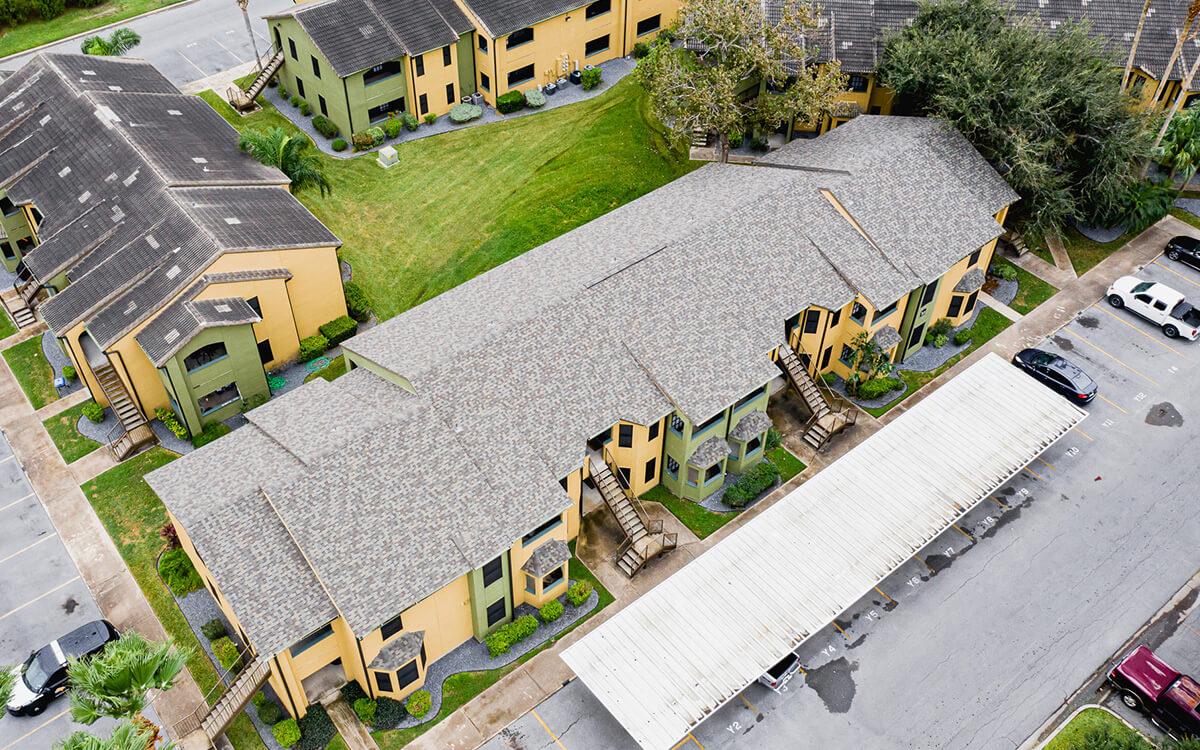
Commercial Shingle Roofing Guide
Commercial shingle roofing can be an excellent investment for the right building, but it isn’t the right fit for every property. For steep-slope apartments, churches, HOA communities, offices, and similar structures, a properly designed shingle system often delivers a strong balance of appearance, wind performance, and long-term value.
The challenge is knowing whether shingles make sense for your building before committing to a major capital expense. A poor roofing decision can shorten the roof’s lifecycle, increase maintenance costs, and create budget headaches for owners, boards, and stakeholders.
Many commercial roofing resources focus on flat roofs or recycle residential advice that doesn’t address the realities of apartment roofing, HOA roofing projects, church facilities, or multi-building commercial properties. Questions about code compliance, wind uplift ratings, contractor qualifications, and total cost of ownership are often left unanswered.
Before you approve a commercial roof replacement in Orlando, Daytona, Kissimmee, Sanford, Port Orange, or Deltona, you need clear information that goes beyond installation costs. The real decision involves lifecycle value, future maintenance requirements, insurance considerations, and how the roof supports your building envelope over the next 20 to 30 years.
What Is Commercial Shingle Roofing?
Commercial shingle roofing refers to asphalt-based roofing systems installed on steep-slope commercial buildings, typically roofs with a pitch of 4:12 or greater. Unlike low-slope commercial roofs that rely on membrane systems such as TPO, EPDM, or modified bitumen, shingle systems protect the building by shedding water through overlapping layers. You’ll most often find commercial asphalt roofing systems on:
- Apartment and condominium communities
- HOA-managed properties
- Churches and religious facilities
- Professional office buildings
- Schools and educational facilities
- Retail centers with sloped roof designs
- Municipal and community buildings
When properly designed and installed, commercial shingle systems can provide an attractive, code-compliant roofing solution with predictable maintenance requirements and competitive long-term ownership costs.
How Commercial Shingle Roofing Differs from Residential Roofing
The roofing system may look similar from the ground, but commercial shingle projects operate under a completely different set of requirements.
Larger Roof Systems and Greater Complexity
A commercial apartment community in Orlando or a church campus in Daytona often has several times the roof area of a typical home. These buildings also contain more roof penetrations, HVAC equipment, ventilation systems, skylights, and drainage transitions that must be integrated without creating leak risks.
Stricter Code and Compliance Standards
Commercial projects are governed by the International Building Code (IBC) and local code requirements, not the residential code used for most homes. Wind resistance, fire classification, structural loading, and energy performance requirements are typically more demanding, particularly in Florida’s high-wind regions.
Higher-Performance Roofing Assemblies
Commercial shingle systems frequently require upgraded underlayments, enhanced fastening patterns, and shingles with wind ratings of 110 to 130 mph or higher. The goal is not simply installing shingles but creating a code-compliant roofing assembly capable of protecting the building envelope during severe weather.
Specialized Contractor Expertise
Not every roofing contractor who installs residential shingles is equipped for commercial work. Commercial roof replacement projects require higher insurance limits, safety programs, project management capabilities, and experience coordinating with property managers, boards, tenants, and multiple stakeholders.
Which Commercial Buildings Are Best Suited for Shingles?
Shingles perform best on steep-slope commercial structures where appearance, lifecycle value, and repairability are priorities.
| Building Type | Typical Roof Pitch | Suitability | Key Considerations |
| Retail centers and strip malls | 4:12–8:12 | High | Flexible aesthetics, easy repairs |
| Churches and religious facilities | 6:12–12:12 | High | Ideal for steep roofs, strong curb appeal |
| Schools and educational buildings | 4:12–8:12 | High | Impact-resistant options available |
| Garden-style apartment communities | 4:12–10:12 | High | Cost-effective for multiple buildings |
| HOA-managed residential communities | 4:12–10:12 | High | Consistent appearance across properties |
| Low-rise office buildings | 4:12–6:12 | Moderate | Compare against metal roofing |
| Industrial facilities and warehouses | Below 4:12 in most cases | Low | Membrane roofing usually preferred |
| High-rise commercial buildings | Varies | Not Recommended | Typically use flat-roof systems |
For many apartment roofing, HOA roofing, and church roofing projects throughout Kissimmee, Sanford, Deltona, and Port Orange, shingles remain one of the most practical solutions because they balance aesthetics, performance, and long-term ownership costs.
When Shingles Are Not the Right Roofing System
A commercial shingle roof is not the best choice for every property. Below are the situations where another roofing system may be a better long-term investment.
1. Low-Slope Roofs
If sections of the roof fall below a 3:12 pitch, shingles become a poor fit. Water drains more slowly on low-slope surfaces, increasing the risk of moisture intrusion beneath the roofing system.
2. Buildings with Extreme Wind Exposure
Coastal properties and hurricane-exposed locations may require enhanced roofing assemblies, specialized fastening schedules, or alternative materials. In some situations, standing seam metal roofing provides a stronger long-term solution.
3. Owners Focused on Maximum Lifespan
If your primary objective is achieving 50 years or more of service life with minimal replacement cycles, premium metal roofing systems often produce a lower total cost of ownership despite a higher initial investment.
Before selecting any roofing system, have a qualified roofing consultant or structural engineer evaluate the roof deck, wind exposure, and existing building conditions. That assessment often reveals issues that are far less expensive to address before installation than after the project is complete.
Commercial Shingle Types Compared
The success of a commercial shingle roofing system depends as much on product selection as installation quality. The wrong shingle can shorten roof life, increase maintenance costs, and reduce the return on your roofing investment.
For most apartment roofing, HOA roofing, church roofing, and low-rise commercial buildings, architectural shingles deliver the strongest combination of durability, wind resistance, appearance, and lifecycle value. Premium and impact-resistant products can make sense in specific situations, but they are not always necessary.
Commercial Asphalt Shingle Comparison
| Shingle Type | Installed Cost Per Square* | Expected Lifespan | Wind Rating | Warranty Length | Best Commercial Application |
| 3-Tab (Standard) | $350–$450 | 15–20 years | 60–70 mph | 20–30 years limited | Short-term or budget-focused projects |
| Architectural (Dimensional) | $450–$600 | 25–30 years | 110–130 mph | Lifetime limited | Most commercial buildings |
| Designer (Premium) | $600–$800+ | 30–50 years | 110–130 mph | Lifetime limited | Churches and high-visibility properties |
| Impact-Resistant (Class 3/4) | $550–$750 | 25–30 years | 110–130 mph | Lifetime limited | Storm-prone areas and insurance-conscious owners |
*Costs represent typical 2026 commercial project pricing, including labor and standard underlayment. Actual pricing varies based on roof complexity, location, accessibility, and project size.
Which Shingle Type Provides the Best Value?
For most commercial roof replacement projects in Orlando, Kissimmee, Sanford, Deltona, Daytona, and Port Orange, architectural shingles are the benchmark product. They typically provide:
- Wind ratings suitable for Florida conditions
- Better durability than standard 3-tab shingles
- Lower lifecycle costs than frequent replacement cycles
- Broad manufacturer warranty coverage
- Strong curb appeal for apartments, HOA communities, churches, and offices
Products such as GAF Timberline HDZ and CertainTeed Landmark are frequently specified because they balance performance, warranty protection, and installation consistency without the premium cost of designer shingles.
A better approach is to match the roofing system to the building’s exposure, ownership timeline, and maintenance strategy rather than focusing solely on upfront cost.
How to Choose the Right Shingle Type for Your Building
Choosing a shingle isn’t just about comparing prices. The best option depends on where your building is located, how long you plan to own it, and what kind of performance you expect over the next few decades.
Start with Wind Exposure
In Florida, wind resistance should be near the top of your checklist. A roof on a church in Daytona or an apartment complex in Port Orange faces very different weather conditions than a building in a more sheltered area.
Before selecting a product, verify your building’s design wind speed and local code requirements. In higher-exposure areas, shingles rated for 130 mph winds typically provide the best protection. Look for products tested under ASTM D7158, the industry standard used to evaluate shingle wind resistance.
Consider Storm and Impact Risk
Not every building needs impact-resistant shingles, but they can be a smart investment in areas that experience frequent hail or wind-driven debris.
Class 3 and Class 4 shingles are tested under UL 2218 impact-resistance standards and are designed to withstand more abuse than standard products. While they cost more upfront, they often reduce repair expenses after severe weather and may qualify for insurance discounts.
Think About Appearance
For some properties, appearance matters almost as much as performance. Churches, professional offices, upscale apartment communities, and HOA-managed neighborhoods often choose designer shingles because they create a more distinctive look. These products offer deeper shadow lines, richer color blends, and profiles that better complement architectural features.
If curb appeal influences tenant attraction, property values, or community perception, premium shingles may justify the additional investment.
Match the Roof to Your Ownership Strategy
A roof that looks affordable today may cost more over time if it requires earlier replacement. For most commercial owners, architectural shingles provide the best balance between upfront cost and long-term value. With a typical service life of 25 to 30 years, they fit well with the ownership horizon of many apartment communities, churches, and commercial properties.
If you expect to hold the property for 15 years or longer, standard 3-tab shingles rarely deliver the strongest return on investment.
If your building is located in an area that sees frequent hail or storm damage, upgrading to Class 3 or Class 4 impact-resistant shingles can pay for itself faster than many owners expect. Lower repair costs and potential insurance savings often help offset the higher initial investment.
Cost Analysis and Budgeting for Commercial Shingle Roofs
Commercial shingle roof replacement costs extend well beyond the shingles themselves. Tear-off work, underlayment, flashing, labor, permits, and potential deck repairs can significantly affect the final project budget.
Typical Commercial Shingle Roofing Cost Breakdown
| Cost Component | Low Range (Per Sq Ft) | High Range (Per Sq Ft) |
| Tear-off and disposal | $1.00 | $2.00 |
| Deck repair or replacement | $0.50 | $3.00 |
| Underlayment | $0.50 | $1.50 |
| Architectural shingles | $2.00 | $5.00 |
| Flashing and accessories | $0.50 | $1.50 |
| Labor | $2.00 | $4.00 |
| Permits and inspections | $0.10 | $0.30 |
| Contingency and waste | $0.60 | $1.50 |
Costs reflect typical 2026 commercial steep-slope roofing averages. Actual pricing varies based on location, roof complexity, building height, and market conditions.
Budget for More Than the Roof Surface
The most common cost overruns occur after tear-off when hidden deck damage is discovered. Code-required upgrades, difficult roof access, and disposal fees can also increase project costs unexpectedly.
Before approving a commercial roof replacement, obtain detailed proposals from multiple contractors and compare the full scope of work, not just the bottom-line price. A lower bid can become more expensive if critical items are excluded from the estimate.
Commercial Shingle Roof Installation
A commercial shingle roof is only as good as the installation behind it. Even premium materials can fail early if the deck, flashing, or fastening details are overlooked. That’s why successful projects start long before the first shingle is installed.
Before Roofing Work Begins
The planning stage determines whether the project runs smoothly or becomes a series of expensive surprises.
Contractors should first verify that the roof structure can support the new roofing system and review local code requirements for wind resistance, fire ratings, and permitting. In many Florida municipalities, permit approval may require engineering documentation, so it’s worth addressing this early in the process.
The most costly roofing problems are often hidden beneath the existing roof. A thorough deck inspection during tear-off can uncover damage before it turns into a warranty issue later.
Exposing and Preparing the Roof Deck
Once the old roofing materials are removed, the deck becomes the focus. Any rotted, weakened, or damaged sheathing should be replaced before new materials are installed.
In higher-wind areas, contractors may also need to add fasteners or re-secure decking to meet current code requirements. Skipping this step can undermine the entire roofing system.
Creating the Secondary Water Barrier
Before shingles go down, the roof needs protection underneath them. Most commercial projects today use synthetic underlayments because they resist tearing, shed water effectively, and hold up better during installation. Around valleys, penetrations, and other vulnerable areas, contractors often install self-adhering waterproof membranes for added protection.
Products such as Grace Ice & Water Shield are commonly specified where maximum moisture protection is needed.
Flashing Details Matter More Than Shingles
Most roof leaks do not start in the middle of a shingle field. They start around transitions, walls, valleys, and penetrations. That’s why experienced commercial roofers pay close attention to:
- Drip edges along roof perimeters
- Sidewall and headwall flashing
- Pipe and vent penetrations
- HVAC curb flashing
- Valley waterproofing systems
These details handle a disproportionate share of water movement across the roof and deserve extra attention during installation.
Installing the Shingles
With the deck and waterproofing complete, the shingle installation begins. Manufacturers specify exact fastening patterns, nail placement zones, and exposure measurements. On commercial buildings exposed to stronger winds, contractors often use six nails per shingle and additional sealing methods to improve wind resistance.
Proper staggering and alignment are equally important. Small installation errors repeated across thousands of square feet can become major performance issues years later.
Ventilation is frequently overlooked during commercial roof replacement. Poor airflow can trap heat and moisture inside the roofing assembly, shortening shingle life and increasing maintenance costs.
Final Inspection and Documentation
Before the project is considered complete, the entire roofing system should be reviewed one final time. The inspection typically includes:
- Flashing and penetration checks
- Shingle alignment verification
- Ventilation system review
- Fastener and workmanship inspection
- Photo documentation for warranty records
Many commercial roofing professionals rely on installation practices outlined by RICOWI and IBHS because they align closely with manufacturer requirements and help support long-term roof performance.
A properly installed commercial shingle roof should not simply look good on completion day. It should be built to withstand years of weather exposure, maintenance traffic, and code scrutiny without creating problems for the building owner.
Maintenance and Lifespan Extension for Commercial Shingle Roofs
Most commercial shingle roofs don’t fail because the shingles reach the end of their lifespan. They fail because minor issues go unnoticed until water finds its way into the building.
A simple maintenance program can add years to the roof’s service life, reduce repair costs, and help preserve warranty coverage. For apartment complexes, HOA properties, churches, and office buildings, routine inspections are often one of the highest-return investments you can make.
Seasonal Commercial Roof Maintenance Checklist
| Season | Maintenance Task | Frequency | Priority |
| Spring | Check for missing shingles and flashing damage | Once | High |
| Spring | Clean gutters and downspouts | Once | High |
| Spring | Inspect sealants around roof penetrations | Once | High |
| Summer | Inspect roof after major storms | As needed | High |
| Summer | Trim overhanging tree branches | Annually | Medium |
| Summer | Verify ventilation systems are unobstructed | Once | Medium |
| Fall | Remove leaves and debris from valleys and gutters | Once | High |
| Fall | Inspect and reseal deteriorated flashing joints | Once | High |
| Fall | Check metal edges for loose fasteners | Once | Medium |
| Winter | Watch for excessive snow loads where applicable | As needed | High |
| Winter | Check ceilings for signs of water intrusion | Monthly | Medium |
| Winter | Monitor for ice dams in colder climates | As needed | High |
Focus on Small Problems Early
The most common maintenance issues are also the easiest to fix when caught early:
- Loose or damaged shingles
- Cracked flashing sealant
- Clogged drainage systems
- Storm-related wind damage
- Ventilation problems
- Tree branch abrasion
Many of these issues can be spotted from the ground during routine property inspections. For anything involving roof access, a qualified commercial roofing contractor should perform the evaluation.
Schedule a professional roof inspection at least once per year and after significant storms. The cost of an inspection is usually insignificant compared to the cost of repairing interior water damage or replacing deteriorated roof decking.
Conclusion
The right commercial roofing decision comes down to four factors: roof pitch, climate exposure, budget, and how long you plan to own the property. For most steep-slope commercial buildings, architectural shingles deliver the strongest balance of durability, appearance, and long-term value. Before requesting proposals, use the 25-year cost framework and contractor checklist to compare your options. Then gather bids from at least three qualified commercial roofing contractors and verify licensing,