
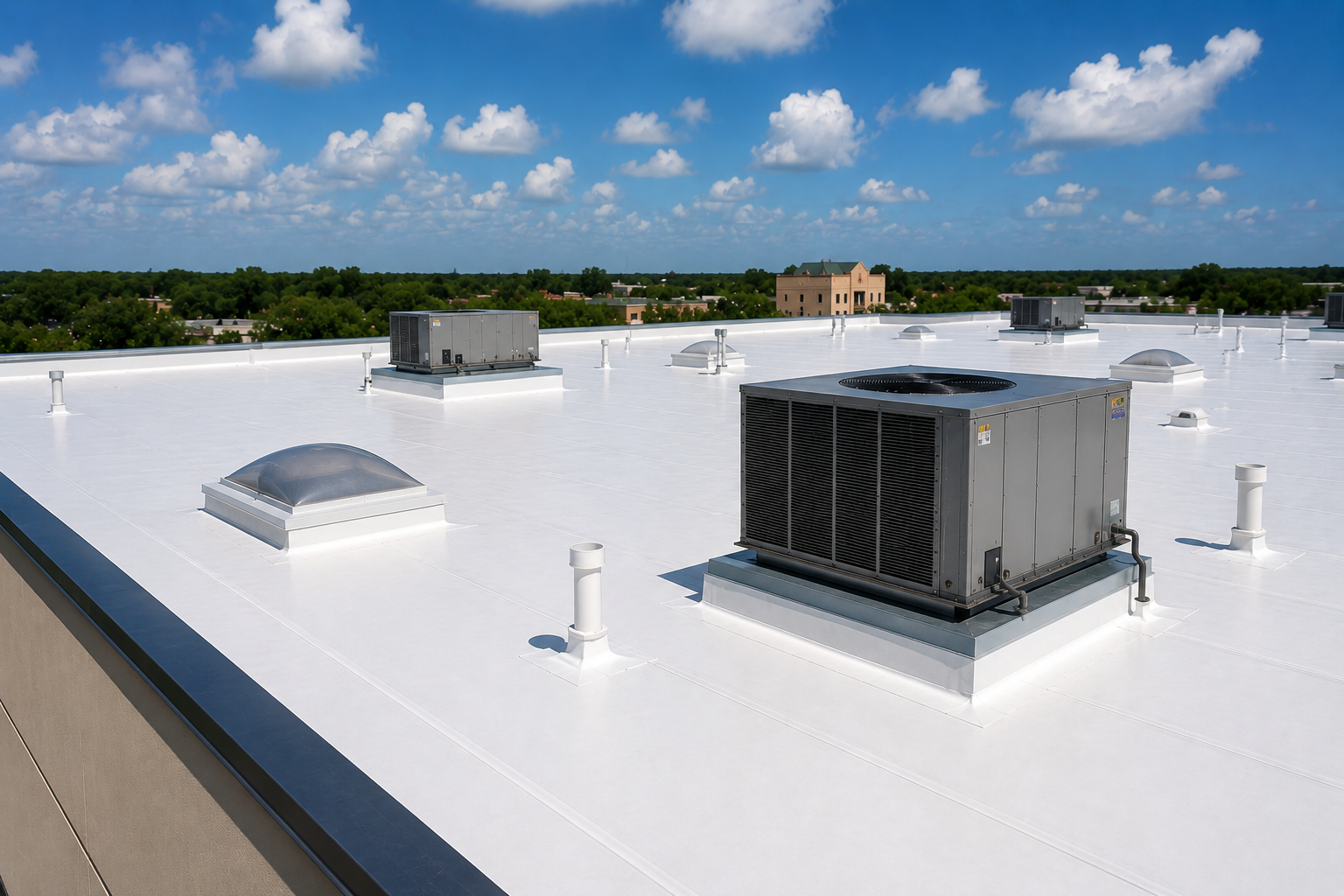
How Long Does a TPO Roof Last?
A properly installed TPO roof typically lasts 15 to 25 years, while high-quality systems can remain in service for 25 to 30 years. In Florida, where roofs in Orlando, Daytona, Kissimmee, and surrounding areas face relentless UV exposure, heat, and heavy rain, reaching the upper end of that range depends more on how the roof is built and maintained than the membrane itself.
The biggest difference comes down to four factors you can control: membrane thickness, installation quality, climate exposure, and ongoing maintenance.
What Independent Research Tells Us
Independent testing supports those numbers. The Western States Roofing Contractors Association (WSRCA) tracked multiple TPO membranes through 10 years of outdoor exposure across different U.S. climates, evaluating real-world weathering rather than laboratory simulations.
Roofs with adequate membrane thickness and well-executed seams showed very little deterioration, reinforcing the expectation of a 20+ year service life when installed correctly.
Technical guidance from IIBEC Technical Advisory No. 012-2016 reaches a similar conclusion: TPO longevity depends far more on workmanship and maintenance than on the membrane alone. That’s why premium systems from manufacturers such as GAF, Carlisle, and Firestone can carry warranties of up to 30 years, provided they’re installed by certified contractors and maintained according to the manufacturer’s requirements.
Why Typical and Maximum Lifespan Are So Different
Most TPO roofs aren’t replaced because the membrane simply wears out. More often, failing seams, damaged flashings, neglected ponding water, or years without inspections shorten the roof’s service life.
By contrast, an 80-mil fully adhered system that receives semi-annual inspections and prompt repairs can often outlast a neglected roof by close to a decade.
Budget around a 20-year replacement cycle, but maintain the roof with the goal of reaching 25 years or more. If it gets there, you’ve reduced lifecycle costs instead of paying for an unexpected replacement.
Key Factors That Determine How Long Your TPO Roof Will Last
1. Membrane Thickness
Not all TPO membranes are built the same. A few extra mils of thickness can mean several more years before you’re budgeting for another roof replacement.
- 45-mil TPO is generally used on light-duty buildings or projects where long-term performance isn’t the main priority. In Florida’s intense sun, it’s rarely the best choice for commercial properties. Expect roughly 12–15 years under normal conditions.
- 60-mil TPO is the most common option for offices, retail buildings, warehouses, and medical facilities around Orlando, Sanford, Deltona, and Kissimmee. It offers a solid balance between durability, puncture resistance, and cost. With regular inspections, 20–25 years is a realistic expectation.
- 80-mil TPO is built for tougher conditions. If your roof sees frequent maintenance traffic, experiences severe weather, or you’re planning to own the building for decades, the extra thickness pays off. A properly installed 80-mil system can often reach 25–30 years.
Don’t compare roofing quotes based on price alone. Two proposals may both say ‘new TPO roof’, while one includes a 45-mil membrane and the other specifies an 80-mil system. That difference has a major impact on lifespan.
2. Installation Quality
We’ve seen premium membranes fail early because of poor workmanship. We’ve also noticed average systems keep performing simply because they were installed correctly. The contractor matters just as much as the material.
Manufacturer-certified installers follow approved welding procedures, inspect every seam, and understand how to detail drains, curbs, HVAC units, and roof edges. Those details determine whether a roof stays watertight for decades or starts leaking after a few seasons.
Seams deserve special attention. A properly heat-welded seam becomes one continuous piece of membrane. A weak weld may look fine on day one but can separate after years of heat, rain, and wind. The attachment method also affects longevity.
- Mechanically attached systems use fasteners to secure the membrane. They’re faster to install and usually cost less but can be more susceptible to wind uplift and fastener movement over time.
- Fully adhered systems bond the membrane directly to the insulation, creating a smoother roof with better wind performance. In many Florida applications, they can extend the roof’s service life by several years.
- Ballasted systems rely on stone or pavers to hold the membrane in place. While they shield the membrane from sunlight, they make leak detection more difficult and aren’t common on many newer Florida commercial buildings.
Every proposal should clearly list the membrane thickness, attachment method, warranty length, and manufacturer. If those details are missing, ask why before signing anything.
3. Climate and Environmental Stressors
Even the best TPO membrane ages faster when it’s exposed to harsh weather every day. In cities like Daytona, Port Orange, Apopka, and Oviedo, constant UV exposure slowly breaks down roofing materials year after year. Modern TPO handles sunlight better than older membranes, but no roof is immune to thermal aging forever.
Many building owners add a reflective roof coating after 10 to 12 years to slow that process and extend the roof’s service life.
Heat isn’t the only challenge. Standing water after heavy storms is one of the biggest lifespan killers. If water remains on the roof for more than 48 hours, seams, flashings, and insulation stay under constant stress. Improving drainage with tapered insulation or correcting low spots is often cheaper than repairing years of moisture damage later.
Temperature swings also matter. As the membrane expands during the day and cools at night, every seam and flashing goes through repeated movement. Fully adhered systems generally handle that cycle better than mechanically attached roofs.
Roofing recommendations also change by climate zone, which is why organizations like ASHRAE and the International Energy Conservation Code (IECC) publish climate maps that contractors use when designing roofing systems. The right membrane for Central Florida isn’t always the right choice somewhere with freezing winters or heavy snow.
4. Maintenance Frequency and Quality
The way a roof is maintained often has a bigger impact on its lifespan than its age. Two buildings with the same TPO system can have completely different outcomes simply because one receives regular care and the other doesn’t.
Schedule professional inspections twice a year, ideally in the spring and fall. These routine checkups catch loose seams, damaged flashings, and small punctures before they become costly leaks.
Storms deserve extra attention. After hurricanes, high winds, or heavy rain, common across Orlando, Deltona, Daytona, and Port Orange, have the roof inspected for membrane damage, debris, or other issues that may not be visible from the ground.
Keep a digital record of every inspection, repair, and maintenance visit, including photos and dates. Good documentation helps support warranty claims and provides a clear maintenance history.
Finally, don’t put off small repairs. A simple puncture can usually be patched quickly, but if left untreated, it can lead to saturated insulation, deck corrosion, mold, and expensive interior damage.
Store a small supply of matching TPO membrane and compatible seam materials on-site. Quick repairs after minor damage can prevent much larger problems later.
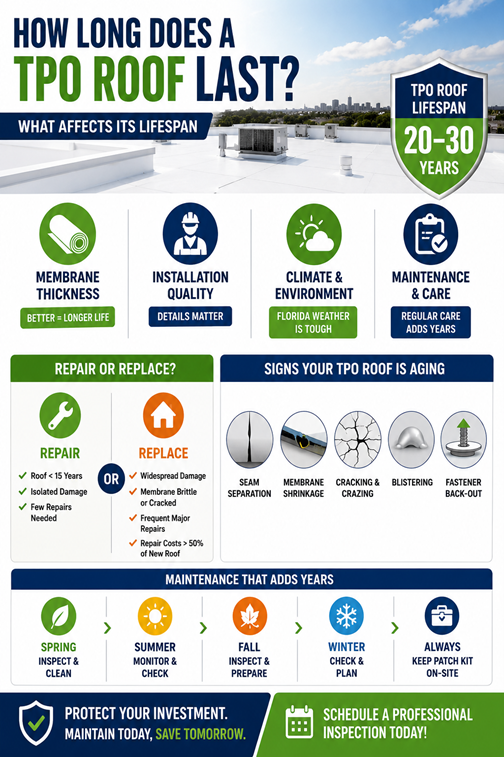
How Proper Maintenance Can Add 5–10 Years to Your TPO Roof
A simple maintenance schedule can add years to your TPO roof. Plan one inspection in spring to clear drains, check seams, flashings, and ponding areas. Schedule another in fall to prepare the roof for the months ahead. After any major storm with high winds or hail, have the roof inspected again for hidden damage.
What Should Be Checked?
Focus on the areas where problems usually begin:
- Seams for gaps or failed welds
- Flashings around HVAC units, walls, and curbs
- Drains and scuppers for debris and standing water
- The membrane for punctures, cuts, or excessive wear
- Interior ceilings for stains or signs of slow leaks
Save photos and records from every inspection and repair. A well-documented maintenance history can help protect your manufacturer’s warranty.
Simple Annual Maintenance Schedule
| Time | Recommended Task |
| Jan–Feb | Check the building interior for leaks and review maintenance records. |
| Mar–Apr | Perform a spring roof inspection and clear drains. |
| May–Aug | Watch for UV wear and ponding water after heavy summer storms. |
| Sep–Oct | Complete a fall inspection and remove leaves and debris. |
| Nov–Dec | Finish outstanding repairs and prepare emergency repair materials. |
Keep an Emergency Patch Kit Ready
Store a small piece of matching TPO membrane, seam tape, a roller, and the proper welding or adhesive tools on-site. When a minor puncture or seam issue is repaired quickly, it is far less likely to turn into a costly leak or moisture problem.
Should You Repair or Replace Your TPO Roof?
When a Repair Still Makes Sense
Repairs are usually the better option when the roof is under 15 years old and the damage is limited to a few punctures, seams, or flashing details. A moisture scan and seam pull test can confirm whether the rest of the roof is still in good condition.
When Should a TPO Roof Be Replaced
Replacement becomes the better long-term choice if seam failures are widespread, the membrane has become brittle, or shrinkage is affecting multiple areas. It’s also worth replacing the roof if expected repair costs over the next few years approach half the cost of a new system, or if you’re dealing with major repairs every year.
Repair or Replace? A Quick Decision
| If your roof… | Best Option |
| Under 15 years old with isolated damage | Repair |
| Has widespread seam failure or severe shrinkage | Replace |
| Needs frequent major repairs | Replace |
| Is structurally sound with minor localized issues | Repair |
Get the Most Out of Your TPO Roof
If you’re unsure how much life your TPO roof has left, don’t rely on age alone. A professional inspection can reveal whether a simple repair will keep it performing for years or if it’s time to start planning for replacement.
Our team provides honest TPO roof assessments for commercial properties throughout Orlando, Deltona, Daytona, Kissimmee, Sanford, Port Orange, and nearby communities. We’ll evaluate your roof’s condition, explain your options, and help you make the most cost-effective decision for your building.
Schedule your TPO roof inspection today and get clear answers before minor issues turn into major expenses.